28 April, 2011

"The Fever" Strikes the ICLC

For the safety of everyone, I would like to put out a warning that there is a minor health risk at the ICLC.  Symptoms of the condition include, a compulsive need to mix in the mass of people in central London (masses which are growing by the minute!), urges to buy tacky memorabilia and facial twitches that resemble excitement.  Yes, Wedding Fever has penetrated our defenses.  William and Kate are getting married and people are traveling the world to see it happen.  We tried to hold off "The Fever" as long as possible, but with ground zero of the outbreak being in the UK itself, we're lucky to have held out so long.
Examples of 2 main symptoms shown here: excitement and tacky memorabilia

The latest victim to be claimed is our Director, Bill Sheasgreen.  In most cases the symptoms are only temporary, and usually dissipate over time (though it is unknown how long they may last).  No cure has been found, and most people are told to wait out the symptoms and hope for the best, but with the fever spreading across the world since last October, it is thought that it will reach epic heights on Friday April 29th, 2011. 

Our thoughts are with Bill as he struggles through the fever.  We are pleased to say that Wedding Fever has not affected Bill's ability to direct the London Centre, it has only caused him to put up contentious decorations in the ICLC.  Sarah and Claire have remained immune throughout the ordeal and hope to continue that way.

-Elsie (who is safely quarantined)

14 April, 2011

Crossing the Border: Scotland

One of the most asked questions students pose when preparing to go to Scotland is, do I need my passport?  There is indeed a border between England and Scotland, but, along with Wales and Northern Ireland, these countries are all part of the United Kingdom of Great Britain and Northern Ireland.  This question put to Brits probably sounds the same as asking an American if you need to show your passport to travel from New York to New Jersey.  No passport is required for either of these border crossings.

Slightly less popular as questions about traveling to Scotland go is, do I need to change my money?  Another no is the answer to this question.  However, you will notice in Scotland that the notes look different.  £10 of Bank of England notes has exactly the same value as £10 of Bank of Scotland notes, £10 of Royal Bank of Scotland notes and £10 of Clydesdale Bank notes.  Yes, there are three banks in Scotland which have the right to produce money, versus one in England, one in Ireland and none in Wales.  All pound sterling notes are acceptable in all parts of the United Kingdom.  Scottish notes are often faced with skepticism in London because they are popular with counterfeiters trying to pass off fake money, but real Scottish notes are unquestionably viable.

My favorite question is, what did that person say?  Some Scottish accents can be difficult to decipher by an untrained ear, but there is every chance that that person really did say, "Deep fried Mars Bars are delicious".  It's a Scottish delicacy and well worth a try!
Bill is seen here preparing a Scottish feast, complete with haggis, Irn-Bru and Mars Bars for deep frying.  The flags in the background give extra Scottish flavour.

-Elsie

05 April, 2011

Keith Moon's plaque at 35 Harrington Gardens

For everyone who was duped into thinking that Keith Moon really is having a blue plaque dedicated to him at 35 Harrington Gardens, here is a rebuttal:

Yes, the ICLC has a truly rockstar past.  There was the time that the Beatles performed their last live performance together on the roof.  No, that was at Apple Corps at 3 Saville Row.  There was the first Live Aid Concert in 1985.  No, that was at Wembley.  There was the broadcast of the music video for Video Killed the Radio Star at 00:01 on 1 August 1981.  No, that was MTV.  Perhaps the rockstar history of 35 Harrington Gardens is a bit more checkered that we had originally thought.  Or perhaps the rockstar history of 35 Harrington Gardens is non-existent.  Did Keith Moon really live here for a short time?

Bill's very plausible fabrication needs to be broken apart to find the holes.  Foremost is the issue of the plaque, itself.  To have a blue plaque put up, you must petition English Heritage.  It can take months, even years to have your petition succeed, and very few do on their first try.  Its sticking point is often the proof required.  Petitioners must submit "Memories" of the person's relationship to the property.  If the person was associated with the property within the last 70 years, then there needs to be "testimony in the form of affidavits from at least 2 unrelated, living sources" who recall the person's presence there.  If no one can be found to give living testimony, then proof of the search's trial and failure must also be delivered with the petition. 

The next step involves the land registry.  If the person resided at the property this information will need to be gathered from there, a process which costs £150 per request.  I imagine we can afford this expense, but it's something to be taken under consideration in comparison to how successful the applicant thinks their petition will be.  These steps can take at least 2 years to complete in some cases.  It's plausible that Bill might have begun this process as one of his initiatives when he became the Director of the London Centre in 1997.  Also, when English Heritage puts a plaque up, it is incorporated into the structure, often involving cutting back into the brick work.  35 Harrington Gardens is a Grade II listed building, which means that we are not allowed to tamper with the exterior of the building.  To get a dispensation to do so is laborious, as only 3 are given per year.  South Kensington, being one of London's poshest areas, has a full history of notable personages.  Having checked with the council, the waiting list for a dispensation is 61 years.  That means that this petition would need to have been started some time before 1950.  Keith Moon wasn't even born until 1946.

Bill, this was one thorough April Fools joke, but we have now seen through it.
W. S. Gilbert's plaque is a recent addition to Harrington Gardens.  I can only imagine how long the neighbors waited for their dispensation.

-Claire (Elsie's plaque should be arriving one of these days)

01 April, 2011

Our Mystery Lodger About to ‘Come Out’

You will have noted that Claire was not at her desk for a week. You might not know where she was or why she was away. The answers are: she was in the USA; she went to Ithaca for the orientation of the summer and fall 2011 groups. The next question is - why wasn’t I doing orientation in the USA? You will also note that, unusually, I did not go on the Wales trip last Friday. The answer to these questions is bound up with an administrative detail that I can now reveal - at least in part. I needed to be here to finalise details of a celebration that will take place here next month.

It begins with an invitation. First, Claire will be looking for 6 work study volunteers to work a special event on Wednesday night April 20th. Second, a lucky 20 of you - names to be drawn from a hat*** - will be invited to the London Centre to a social gathering with speeches, etc.  Sounds boring, but it won’t be, because a piece of rock and roll history of swinging 1960's London will occur that night. The IC Board of Trustees, in cooperation with English Heritage, and with the encouragement of the Mayor’s Office for London and London 2012 [Cultural Olympiad], has agreed to the placing of a ‘blue plaque’ on the front of our building.  There will be press here, acquaintances of the person to be honoured, and representatives from the home campus including a reporter from The Ithacan.. The project is also part of London 2012, creating more opportunities for tourists to explore interesting parts of the city when not at the Games. [The week after, English Heritage will again be in the area unveiling a plaque to the Irish writer, Samuel Beckett, who lived penniless in a room on Wetherby Gardens in the 1930s.] For an example, see the plaque to W S Gilbert on number 39 Harrington Gardens.

What’s happening?  Kensington & Chelsea records reveal that a well known rock musician, who died in the 1970s, lived and worked at 35 Harrington Gardens between May 1965 and April 1968. He was even arrested here in 1966 after a police raid found illicit substances on the premises [you can read about it in the September 15th, 1966 edition of the Kensington Chronicle.] He was not the only such 1960s rocker to live nearby. Brian Jones, the first leader of the Rolling Stones, lived at number 15 Courtfield Road [one street north of us] in the 60s and John Lennon, his first wife, Cynthia, and  baby son, Julian, lived at 9 Emperor’s Gate [now demolished] just the other side of the Cromwell Road. A blue historical plaque, placed just over the window of Claire’s office will be unveiled at 5 pm on April 20th.  The Lady Mayor of the Royal Borough, Councillor Janice Roberts-Smith, will unveil the plaque, along with a member of the IC Board of Trustees and one of the deceased rocker’s fellow band members. I‘m not at liberty to tell you who, but I can give you a hint. Even I have heard of this band, although I don‘t own any of their music. CLUE: There are 3 surviving members of the band, one with the first initial ‘J’, one with the first initial ’P’ and the un-veiler has the initial ‘R‘. The first 6 letters of the name of one of our faculty members are also the first six letters of the musician’s name. THE FIRST TO GUESS THE IDENTITY OF OUR MYSTERY LODGER GETS A FIVER.

The deceased musician never married, but had a string of girlfriends during this period, one of whom, bore him a son in July 1967. She lived in number 35 for 13 months and raised their child here for the first 6 months of his life. [Unfortunately much like Cynthia Lennon who came upon John bunked down with Yoko Ono in their Surrey mansion in 1967, our hero (?), like a true rock star, was something of a philanderer who was often found with his trousers around his ankles. She left him and went back to her native Germany where she raised her son and became good friends with Astrid Kirchherr, the 5th Beatle Stuart Sutcliffe’s fiance.]

The highlight of the evening from my perspective is that the woman will do a mini walking tour of the building explaining the layout of the rooms in her period of residence. So on April 20th, we will know where the master bedroom was [was it room 5, 4, 2??] where the music rooms were, and where the parties were held [has to be the common room].

Hope you’re one of the 20.

***NB. Attendance at a play or musical event, backstage tour etc., takes precedence over the event.

-Bill
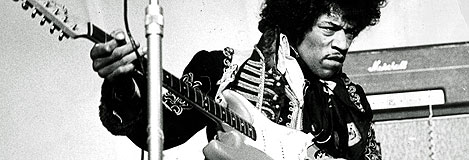
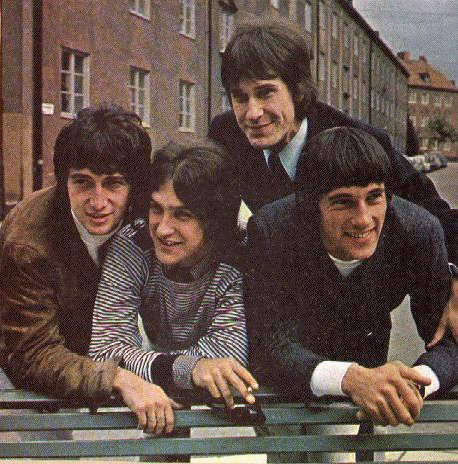
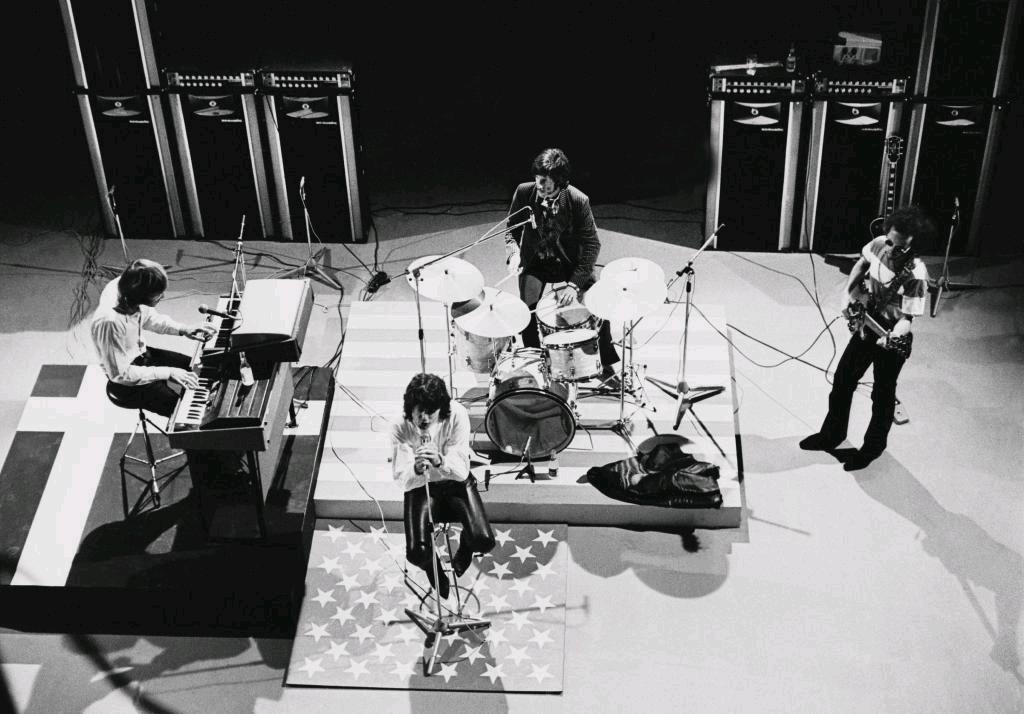
Could it be any of the well-known artists shown here?

18 March, 2011

S11 Scavenger Hunt #4: Swans and Honours

The scavenger hunt needs more attention!  It's been a while since I have posted anything new for the scavenger hunt, so this week I will post something old.  The inspiration for this one is the Stratford trip that most of the ICLC students have left for today.  Stratford wouldn't be what it is today if William Shakespeare hadn't been born there.  Dr. Tim Kidd would have so much less to talk about on his walking tour of Stratford without Shakespeare.  Lucky for Stratford, that is where the playwright came from.  As a result the Royal Shakespeare Theatre was created here and is placed picturesquely on the side of the River Avon.  The River Avon is home to many swans who swim there and walk along the banks of the river.  As a result of the profusion of swans they have become symbols in the town.  The smaller of the Royal Shakespeare Company's theatres is called The Swan and the pub down the road is called the Black Swan.  This pub is a favorite after-theatre hang out.  But the Black Swan is not what it's called colloquially... We saw this one in last fall's scavenger hunt, but it's a favorite of mine.  Your task is to find the most interesting pub name that you can.  If Bill could enter the competition he would submit the Queen and Beaver Public House that he saw in Montreal, Canada.  But that's not in the UK, so it's ineligible.  Plus Bill is a judge of the competition, so he can't enter anyway.

Your second task, in honor of the Honors Program coming over to London with Jack Hrkach, is to find someone who has had an honour bestowed on them.  This can be Sir Elton John, Sir Paul McCartney or Dame Judi Dench, or it can be an image of King Edward III, founder to the Most Notable Order of the Garter in 1348 or 1344 (Order of the Garter).  Be creative like Mr. and Mrs. Cross who named their daughter Victoria.  That's a true story.

-Elsie (she didn't go on the Stratford trip)

03 March, 2011

Bill’s First European Adventure: Hans, the 2 Susies and Martin Heidegger!

Like you, I was a study abroad student in my early 20s – just a few years ago now! Except, I guess that it wasn’t really a study abroad experience as I was full time in a British university and we didn’t have any “fall break”, but we did have a huge Easter break. We also had “winter break”, which lasted about 5 weeks between the beginning of December and the middle of January.

So, what to do in my first ‘break’ period when studying abroad? The answer came in the shape of two buddies on the university basketball team, Paul and Jeff. Paul had bought a second-hand Volkswagen beetle [named “Hans” – Paul was an American of German extraction and was training for the Lutheran priesthood] and he, Jeff [from Boston], Chris [an anthropology student from Berkeley who impressed me throughout the trip by reading Heidegger’s Sein und Zeit [Being and Time] in the back of the beetle, and I took off on a trip to Morocco.  Morocco was a pretty exotic destination way back then for four inexperienced North American travellers. We didn’t have credit cards, nor had ATMs been invented way back in the Neolithic 1960s. We carried our cash - francs, pesetas and sterling – with us. We kept to the back roads through France and Spain as the European motorway – first invented by Hitler in the 1930’s – had not spread far from the land of its birth. In France, we stayed in that great chain of French Hotels – the Hotels de la Gare – which are conveniently located adjacent to the railway station in every middle- sized French town. I thought at the time that, if I were a business student and not an Egyptologist [which I was, believe it or not], I would do a thesis on the business acumen of the “De la Gare” family. What foresight to have established a hotel in such proximity to the railway station in just about every French town! In Spain we stayed in pensiones: hostels hadn’t been invented yet.

We had a great time in Paris where we met two young women, both called Susie, from the University of South Carolina who were studying in Lyon. The wine flowed and a good time was had. We discovered that the French approach to plumbing – public urinals for the messieurs – and the all too familiar “hole in the ground” indoor toilets – was both more liberal and more primitive that was our custom. And none of us had ever seen a bidet before! The British at least – god bless them – had sit-down toilets; long may Mr Thomas Crapper, the inventor of the modern water closet, be remembered and praised for his invention. As I was from French Canada, I was the designated French speaker and interpreter. I remember my embarrassment and confusion in central France when I asked for “pain” in a “boulangerie” and the serving women didn’t understand me. In retrospect, it wasn’t the Quebecois accent.  Rather it was my cultural ignorance: just asking for “bread” in a bread shop didn’t work; one has to know the names of the different kinds of loaf on sale. So my 15 years of French were all to no avail because the French were far more sophisticated about bread than we lamentable, one-dimensional, sliced-bread eating North Americans. Later on, when the Volkswagen broke down in freezing weather in a snowstorm on the outskirts of Paris, I had to hitch a lift along the highway to get to a garage and ask for a replacement “distributor cap”. Except that I didn’t know the French term for “distributor cap”: it is not, for example, the “chapeau du distributeur” as it should have been; nor was it “le distributor cap” as the weekend is “le weekend”; instead it was, and probably still is, “le tete du delco”, a piece of French trivia that I have never forgotten because of the pain and anxiety it caused me at the time.
Spain was decidedly more foreign than France was, but nothing could have prepared us for Morocco. We visited Tangiers, Rabat and Fez. The first two were reasonably “modern” cities, but it
 was hard to know if we were in the 14th century or the 20th century in Fez. Fez was distinctly “untouristy” and made us aware of the enormous cultural gap that existed between Moroccans of the interior and North Americans.  I remember feeling uncomfortable in Fez: although we were humble students, we were westerners and incomparably better off than most of the people in Fez.

We spent more time in Spain on the return trip. On New Year’s eve in Valencia, I ran into a guy I played football with in Montreal. We had both graduated from college about 7 months previously. In France, we stopped in Lyon to meet the two “Susies”, the girls from South Carolina we had met in Paris on the way down.  Then “Hans” broke down: first the windshield wipers went, then the distributor cap. We were all glad to see the white cliffs of Dover. Although we had only been in England since September, it was now our “home”. I bought a copy of Heidegger’s Sein und Zeit. And, no, I haven’t finished it and wouldn’t know even where it is.

No doubt many of you will feel the same after returning from spring break. Have a great time and be careful out there. In my next blog I might just get around to telling you about my first ever spring break, also with the two Susies!

-Bill

An ICLC Tradition

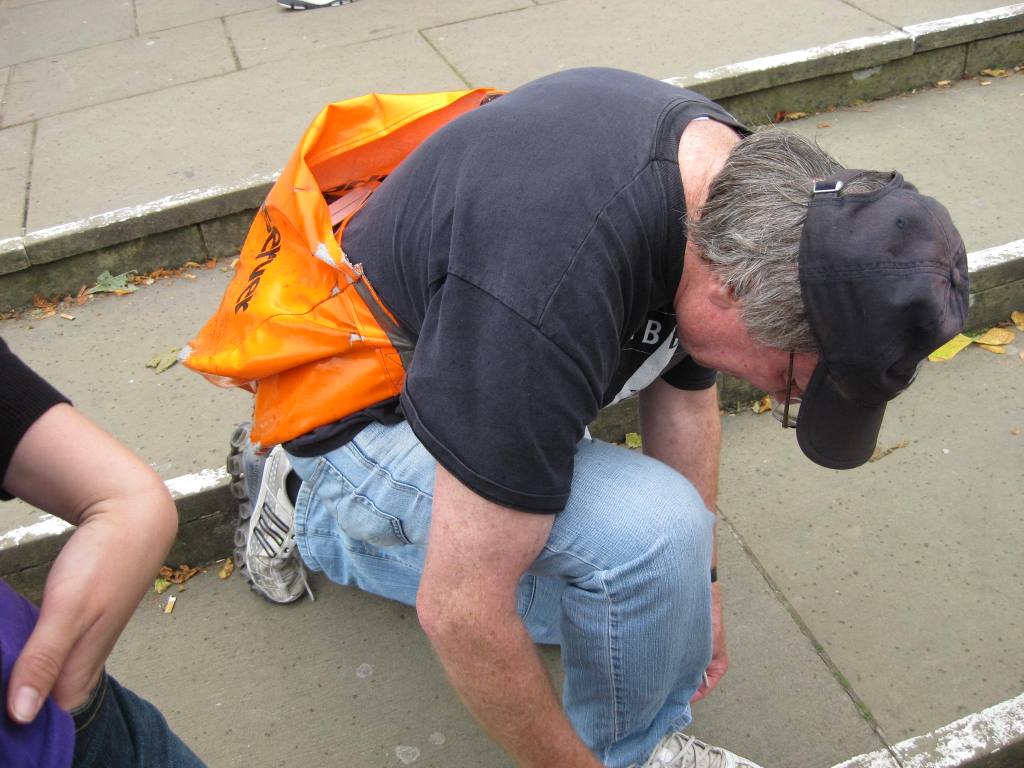
A few things have happened recently that have gotten me thinking.  Completely independently of each other, last week was London Fashion Week, and yesterday my friend wrote into the Guardian newspaper and her comments were published online!  Yes, you guessed it, the combination of fashion and the Guardian can only get one thinking about Bill's orange Guardian bag.  This bag has come to be an icon of many good things.  It represents walks with Bill when that bright, safety-orange bag was the only way you could find Bill to catch up with him in a crowd.  It represents what used to be the prize for the travel writing competition at the end of the term.  I remember being a student back in Ithaca seeing these very bright bags around campus and a friend of mine, who had just come back from his semester in London, looking at it mournfully and wishing he were back in London.
Fall, 2009
This is where we encounter the real issue.  This bag is disappearing from our lives.  The Guardian doesn't make them anymore, so we can no longer give them as prizes, and Bill's bag, which he has carried for many years, looks all the worse for wear.  The Guardian bag is becoming more and more a thing of the past.  Change is good, and Bill has a new bag now.  It's made by Manhattan Portage, it's more on the red side of safety-orange, and has a reflective silver stripe across it.  Content-wise, it probably carries about as much as the old Guardian bag, plus has a zip pocket on the front.  The new bag is held closed with velcro and also clips to hold it closed for extra security.  Bill didn't need this "extra security" in the old bag, he claims all he did with that one was carry really old sandwiches to put strangers off of reaching in and trying to steal term papers from him.  My main issue with all of this, though, is that Bill is a historian by trade.  His Guardian bag has iconic status with alums and symbolizes excellence in writing and walking tours all over London.  It's an ICLC tradition and it's fading in our midst.  Is it possible to begin a "Save the Guardian Bag" campaign?
Summer, 2007

I have looked on eBay, on Amazon, on the Guardian's website and come up empty handed.  These bags seem nowhere to be found.  Perhaps there is a museum out there that would like to de-accession a Guardian bag? 

Bill has a birthday coming up.  Any leads on Guardian bags would be much appreciated.

Thanks.
-Claire

Previous Posts