Showing posts with label Sp '11. Show all posts

23 December, 2011

Celebrating 100 rather than 40 for a change

I've just spotted that this is our 100th post.  I'd like to say that my delay in putting this up has been because I wanted to attach importance to our 100th, but that's not true.  As so often happens, I have been a bit stumped for ideas.  And then our first student of the spring semester arrived (yes, already!), and I had an idea!

I'm going to make comparisons:
  • Last year at this time we still had Fall 2010 students stranded at the ICLC due to adverse weather conditions at Heathrow.  The Fall '11 students mostly left 2 weeks ago.
  • 53 students just returned to America.  125 will shortly be arriving.
  • Last year's Doctor Who Christmas Special had Catherine Jenkins.  This year it has Bill Bailey.
  • Last spring we had one visiting faculty member from the home campus teaching at the ICLC.  This spring we have 3.
I'm going to state some little known facts:
  • Keith Moon is posthumously developing an interesting relationship with the ICLC.
  • Kenneth Branagh is the ICLC's bizarre watchman.
  • We aren't sure, but there's compelling evidence that Bill may live in the ICLC.
  • Jack Hrkach believes in Elsie.  So do the rest of the staff.
I'm going to dispense some advice:
  • If you can't carry it, you've packed too much luggage.
  • Toiletries are heavy.  Buy them when you get here.  Similarly, so are peanut butter and mac and cheese.  Eat like a native for a few months!
  • Make sure your money is in your checking, NOT your savings.  If you are drawing from an ATM you will not get a choice to take from your savings.
  • Keep up to date on what's happening here.  bbc.co.uk
Spring 2012, we'll see you soon!  Fall 2011, I hope you're missing us already!  Spring 2011, the sandwich press is safe!  Fall 2010, what were you doing at this time last year?

-Claire

10 May, 2011

If we were eligible...

Yesterday I posted the travel writing competition winner.  Today the End of Term Party continues with the ICLC's entries into the photo competition.  Of course we can't enter the real competition, and we probably wouldn't win if we did.  My caveat is this: Bill, Sarah and I like taking strange photos.  It keeps our lives interesting.  You know you do it, too.
People: A hard day's night for Claire.  I had to choose between coloring in John Lennon's face or a yellow submarine! (photo entry by Bill)
Architecture: Look what returned back home to the ICLC this weekend!  Sadie, you're off the hook and I hope you put that toaster bag to good use.  No more cold cheese and jam sandwiches for us! (photo entry by Claire)

Landscape: William Shakespeare was married to Anne Hathaway in a shotgun wedding.  Their first child, Suzanna, was born 6 months later.  Rumor has it Suzanna was conceived in the bushes somewhere between Stratford-Upon-Avon and Shottery, a small village to the west of Stratford where Anne's family lived.  Has Bill found that bush? (photo entry by Sarah)

Bill, Sarah, Heather and I hope you all miss us already!  We had a great time this spring!

-Claire 

09 May, 2011

Be Fearless

It's that time of the semester again.  Suitcases are packed, flats are cleaned and emptied and students trickle out of London.  Also, the semester's travel writing winner was announced at the End of Term Party this past Friday!  Turned into this week's guest blogger, we would like to congratulate Michele Fortier and her fearlessness.

My finger hovered over the “Purchase” button, hesitating as my brain ran through every possible challenge and scenario I might soon encounter if I clicked it.  The possibilities were endless, an entire world of problems could arise, and yet, I knew if I did not do it, I would regret it tremendously.  My finger trembled as I clicked the button; there was no going back now.

I had just purchased a roundtrip ticket to Positano, a small cliff side town on the Amalfi Coast in Southern Italy.  It was the first time I would be traveling alone to a country I had never visited before with a language I could not speak.  On every past trip I had undertaken, I always traveled with the security of my friends, depending on them to obtain maps and decide where to go.  I was always the follower in the group, not the leader.  Suddenly, I was putting myself into a situation where I had no one else to rely on so if anything went wrong, I had to take care of it myself. To say I was terrified would be a huge understatement.

The morning of my departure, I sat in the airport, my heart pounding from nerves and my mind racing on overdrive.  I was as ready as I would ever be.  This was it.  Time to throw myself into the unknown.  “Be Fearless.”  That would be my motto.  I even wrote it out on my hand as a reminder.

I flew into Naples in the early afternoon but I still had to catch two buses before reaching my destination.  If I missed either bus, I could very well end up stranded without any back up plan and no way to reach my hostel.  My preplanning, however, had helped as the entire journey went off without a hitch.  At 7:30pm, I climbed down from the bus in Positano, Italy, just in time to see the last few moments of the sunset. 

After unpacking in the hostel, I sat in the common room eating some delicious Italian pizza wondering “Now what?”  What exactly was I going to do for the next four days?  I had chosen Positano because I was tired of visiting city after city; they had all begun to resemble each other in an undistinguishable mass.  I had chosen this town because I wanted time to rejuvenate myself and avoid crowded streets, time to immerse myself in a culture that was not entirely stifled by modern tourism.  Yet, now that I was here, what exactly was I going to do?

It was at that precise moment when I met Hannah, an Australian girl studying in Leeds, England, who had taken the weekend off to travel through Italy.   As I sat there, eating the last slice of my delicious pizza, she told me of her adventures she had had in Positano.  She told me of the places she had been to and the people she had met.  I was envious of all the exciting things she had done.   I desperately wanted to have adventures like that, but I was unsure of where to start.  Then, she offered me a solution. 

“Hey, I met some Italian guys while I’ve been here who are taking me out for dessert later tonight, care to join?”

My initial thought was to reply with a polite, “Thank you, but no,” as I had always been a cautious girl who never went off with strangers, especially alone in a foreign country.  But for some reason, I couldn’t let those words pass from my lips.  I couldn’t shake the motto I had scribbled on my hand: “Be Fearless.”
Before I could even allow my over-analytical brain a second to consider all the possible outcomes of this evening, I replied, “Sure, I’ll come,” and sealed my fate.

That night was the beginning of a brilliant weekend.  I spent the evening with some locals, had my first sip of the local favorite drink, Limoncello, and tasted four different mouthwatering desserts.  I returned to the hostel that night exhausted and happy, excited to see what the rest of the weekend would hold in store.

I spent the next day by the beach, writing in my journal as I allowed my pale body to soak up the hot Mediterranean sun (a decision I would later regret as I rubbed aloe lotion onto my lobster-red skin).  While growing up, I had always had a deep connection to the ocean, and being here cleared up my mind and made everything beautiful.  The power of the waves lapping at my toes complimented itself perfectly with the peace I finally felt in my mind.  Everything was perfect.

Over the next two days, I became closely acquainted with Positano and all of the beautiful things available in this town.  I walked to and from the beach (approx 800 stairs one way) four times over those two days, much to the dismay of my calves.  I watched the sunset on the beach, explored every part of the town, ate my fill of Gelato and Pizza and met many other travelers staying at the hostel. 

On Saturday night, I sat around a large table on the hostel’s terrace with other travelers and shared drinks and anecdotes.  We laughed about our craziest travel experiences and discussed the differences in our cultures.  I met people from Australia, US, Spain, Italy and Thailand.  They were all so friendly and outgoing; after just one evening, I felt as though we had known each other for years.  We all went dancing by the beach until four in the morning and spent the long walk back to the hostel laughing and sharing stories as the sun came up.  We had become such a close-knit group in such a short time and I silently dreaded Monday morning when I would say my goodbyes. 

That Monday came far sooner than I had hoped and expected, and before I could even wrap my mind around what was happening, I was seated on a bus headed back to Naples Airport.  I watched as Positano faded into the distance, quickly becoming hidden behind the cliff side.  I tried to hold back the sudden tears I could feel welling up in my eyes.

I wanted to stay in this town and hold on to every amazing experience.  I wanted to relive every second and bask in the amazingly liberated feeling that had come with my independence.  I realized how much I had missed on other trips when I had failed to explore, meet people and befriend locals because I was so stuck in my safety net of friends.  This weekend had shown me what amazing things could happen when you just let go of everything holding you back and just dive in, headfirst. 

I suddenly felt empowered by this new realization.  I could do anything and go anywhere; all the strength I needed was inside of me.  On that bus ride back to the airport, I began planning my next trip to Italy.  I would come back to Italy, of that I was certain.  As I glanced out the window at the crystal blue waters of the Amalfi Coast, I was struck with one last lingering thought about this weekend:  I had been Fearless.

28 April, 2011

"The Fever" Strikes the ICLC

For the safety of everyone, I would like to put out a warning that there is a minor health risk at the ICLC.  Symptoms of the condition include, a compulsive need to mix in the mass of people in central London (masses which are growing by the minute!), urges to buy tacky memorabilia and facial twitches that resemble excitement.  Yes, Wedding Fever has penetrated our defenses.  William and Kate are getting married and people are traveling the world to see it happen.  We tried to hold off "The Fever" as long as possible, but with ground zero of the outbreak being in the UK itself, we're lucky to have held out so long.
Examples of 2 main symptoms shown here: excitement and tacky memorabilia

The latest victim to be claimed is our Director, Bill Sheasgreen.  In most cases the symptoms are only temporary, and usually dissipate over time (though it is unknown how long they may last).  No cure has been found, and most people are told to wait out the symptoms and hope for the best, but with the fever spreading across the world since last October, it is thought that it will reach epic heights on Friday April 29th, 2011. 

Our thoughts are with Bill as he struggles through the fever.  We are pleased to say that Wedding Fever has not affected Bill's ability to direct the London Centre, it has only caused him to put up contentious decorations in the ICLC.  Sarah and Claire have remained immune throughout the ordeal and hope to continue that way.

-Elsie (who is safely quarantined)

14 April, 2011

Crossing the Border: Scotland

One of the most asked questions students pose when preparing to go to Scotland is, do I need my passport?  There is indeed a border between England and Scotland, but, along with Wales and Northern Ireland, these countries are all part of the United Kingdom of Great Britain and Northern Ireland.  This question put to Brits probably sounds the same as asking an American if you need to show your passport to travel from New York to New Jersey.  No passport is required for either of these border crossings.

Slightly less popular as questions about traveling to Scotland go is, do I need to change my money?  Another no is the answer to this question.  However, you will notice in Scotland that the notes look different.  £10 of Bank of England notes has exactly the same value as £10 of Bank of Scotland notes, £10 of Royal Bank of Scotland notes and £10 of Clydesdale Bank notes.  Yes, there are three banks in Scotland which have the right to produce money, versus one in England, one in Ireland and none in Wales.  All pound sterling notes are acceptable in all parts of the United Kingdom.  Scottish notes are often faced with skepticism in London because they are popular with counterfeiters trying to pass off fake money, but real Scottish notes are unquestionably viable.

My favorite question is, what did that person say?  Some Scottish accents can be difficult to decipher by an untrained ear, but there is every chance that that person really did say, "Deep fried Mars Bars are delicious".  It's a Scottish delicacy and well worth a try!
Bill is seen here preparing a Scottish feast, complete with haggis, Irn-Bru and Mars Bars for deep frying.  The flags in the background give extra Scottish flavour.

-Elsie

05 April, 2011

Keith Moon's plaque at 35 Harrington Gardens

For everyone who was duped into thinking that Keith Moon really is having a blue plaque dedicated to him at 35 Harrington Gardens, here is a rebuttal:

Yes, the ICLC has a truly rockstar past.  There was the time that the Beatles performed their last live performance together on the roof.  No, that was at Apple Corps at 3 Saville Row.  There was the first Live Aid Concert in 1985.  No, that was at Wembley.  There was the broadcast of the music video for Video Killed the Radio Star at 00:01 on 1 August 1981.  No, that was MTV.  Perhaps the rockstar history of 35 Harrington Gardens is a bit more checkered that we had originally thought.  Or perhaps the rockstar history of 35 Harrington Gardens is non-existent.  Did Keith Moon really live here for a short time?

Bill's very plausible fabrication needs to be broken apart to find the holes.  Foremost is the issue of the plaque, itself.  To have a blue plaque put up, you must petition English Heritage.  It can take months, even years to have your petition succeed, and very few do on their first try.  Its sticking point is often the proof required.  Petitioners must submit "Memories" of the person's relationship to the property.  If the person was associated with the property within the last 70 years, then there needs to be "testimony in the form of affidavits from at least 2 unrelated, living sources" who recall the person's presence there.  If no one can be found to give living testimony, then proof of the search's trial and failure must also be delivered with the petition. 

The next step involves the land registry.  If the person resided at the property this information will need to be gathered from there, a process which costs £150 per request.  I imagine we can afford this expense, but it's something to be taken under consideration in comparison to how successful the applicant thinks their petition will be.  These steps can take at least 2 years to complete in some cases.  It's plausible that Bill might have begun this process as one of his initiatives when he became the Director of the London Centre in 1997.  Also, when English Heritage puts a plaque up, it is incorporated into the structure, often involving cutting back into the brick work.  35 Harrington Gardens is a Grade II listed building, which means that we are not allowed to tamper with the exterior of the building.  To get a dispensation to do so is laborious, as only 3 are given per year.  South Kensington, being one of London's poshest areas, has a full history of notable personages.  Having checked with the council, the waiting list for a dispensation is 61 years.  That means that this petition would need to have been started some time before 1950.  Keith Moon wasn't even born until 1946.

Bill, this was one thorough April Fools joke, but we have now seen through it.
W. S. Gilbert's plaque is a recent addition to Harrington Gardens.  I can only imagine how long the neighbors waited for their dispensation.

-Claire (Elsie's plaque should be arriving one of these days)

01 April, 2011

Our Mystery Lodger About to ‘Come Out’

You will have noted that Claire was not at her desk for a week. You might not know where she was or why she was away. The answers are: she was in the USA; she went to Ithaca for the orientation of the summer and fall 2011 groups. The next question is - why wasn’t I doing orientation in the USA? You will also note that, unusually, I did not go on the Wales trip last Friday. The answer to these questions is bound up with an administrative detail that I can now reveal - at least in part. I needed to be here to finalise details of a celebration that will take place here next month.

It begins with an invitation. First, Claire will be looking for 6 work study volunteers to work a special event on Wednesday night April 20th. Second, a lucky 20 of you - names to be drawn from a hat*** - will be invited to the London Centre to a social gathering with speeches, etc.  Sounds boring, but it won’t be, because a piece of rock and roll history of swinging 1960's London will occur that night. The IC Board of Trustees, in cooperation with English Heritage, and with the encouragement of the Mayor’s Office for London and London 2012 [Cultural Olympiad], has agreed to the placing of a ‘blue plaque’ on the front of our building.  There will be press here, acquaintances of the person to be honoured, and representatives from the home campus including a reporter from The Ithacan.. The project is also part of London 2012, creating more opportunities for tourists to explore interesting parts of the city when not at the Games. [The week after, English Heritage will again be in the area unveiling a plaque to the Irish writer, Samuel Beckett, who lived penniless in a room on Wetherby Gardens in the 1930s.] For an example, see the plaque to W S Gilbert on number 39 Harrington Gardens.

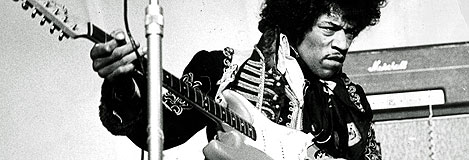
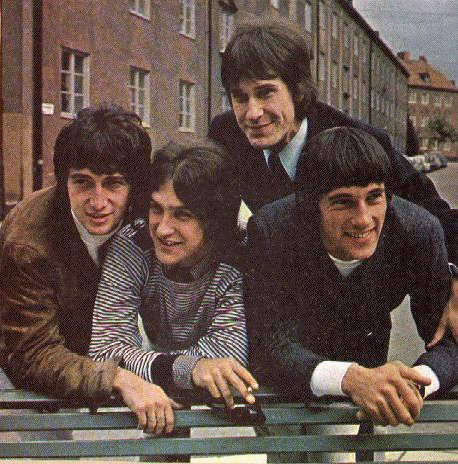
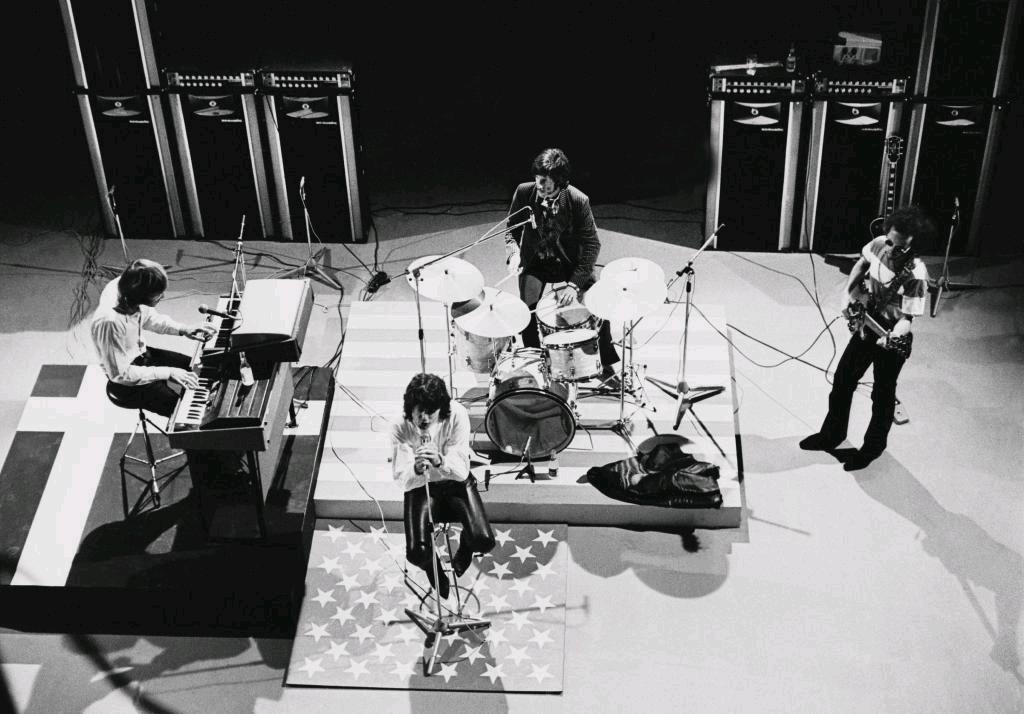
What’s happening?  Kensington & Chelsea records reveal that a well known rock musician, who died in the 1970s, lived and worked at 35 Harrington Gardens between May 1965 and April 1968. He was even arrested here in 1966 after a police raid found illicit substances on the premises [you can read about it in the September 15th, 1966 edition of the Kensington Chronicle.] He was not the only such 1960s rocker to live nearby. Brian Jones, the first leader of the Rolling Stones, lived at number 15 Courtfield Road [one street north of us] in the 60s and John Lennon, his first wife, Cynthia, and  baby son, Julian, lived at 9 Emperor’s Gate [now demolished] just the other side of the Cromwell Road. A blue historical plaque, placed just over the window of Claire’s office will be unveiled at 5 pm on April 20th.  The Lady Mayor of the Royal Borough, Councillor Janice Roberts-Smith, will unveil the plaque, along with a member of the IC Board of Trustees and one of the deceased rocker’s fellow band members. I‘m not at liberty to tell you who, but I can give you a hint. Even I have heard of this band, although I don‘t own any of their music. CLUE: There are 3 surviving members of the band, one with the first initial ‘J’, one with the first initial ’P’ and the un-veiler has the initial ‘R‘. The first 6 letters of the name of one of our faculty members are also the first six letters of the musician’s name. THE FIRST TO GUESS THE IDENTITY OF OUR MYSTERY LODGER GETS A FIVER.

The deceased musician never married, but had a string of girlfriends during this period, one of whom, bore him a son in July 1967. She lived in number 35 for 13 months and raised their child here for the first 6 months of his life. [Unfortunately much like Cynthia Lennon who came upon John bunked down with Yoko Ono in their Surrey mansion in 1967, our hero (?), like a true rock star, was something of a philanderer who was often found with his trousers around his ankles. She left him and went back to her native Germany where she raised her son and became good friends with Astrid Kirchherr, the 5th Beatle Stuart Sutcliffe’s fiance.]

The highlight of the evening from my perspective is that the woman will do a mini walking tour of the building explaining the layout of the rooms in her period of residence. So on April 20th, we will know where the master bedroom was [was it room 5, 4, 2??] where the music rooms were, and where the parties were held [has to be the common room].

Hope you’re one of the 20.

***NB. Attendance at a play or musical event, backstage tour etc., takes precedence over the event.

-Bill
Could it be any of the well-known artists shown here?

18 March, 2011

S11 Scavenger Hunt #4: Swans and Honours

The scavenger hunt needs more attention!  It's been a while since I have posted anything new for the scavenger hunt, so this week I will post something old.  The inspiration for this one is the Stratford trip that most of the ICLC students have left for today.  Stratford wouldn't be what it is today if William Shakespeare hadn't been born there.  Dr. Tim Kidd would have so much less to talk about on his walking tour of Stratford without Shakespeare.  Lucky for Stratford, that is where the playwright came from.  As a result the Royal Shakespeare Theatre was created here and is placed picturesquely on the side of the River Avon.  The River Avon is home to many swans who swim there and walk along the banks of the river.  As a result of the profusion of swans they have become symbols in the town.  The smaller of the Royal Shakespeare Company's theatres is called The Swan and the pub down the road is called the Black Swan.  This pub is a favorite after-theatre hang out.  But the Black Swan is not what it's called colloquially... We saw this one in last fall's scavenger hunt, but it's a favorite of mine.  Your task is to find the most interesting pub name that you can.  If Bill could enter the competition he would submit the Queen and Beaver Public House that he saw in Montreal, Canada.  But that's not in the UK, so it's ineligible.  Plus Bill is a judge of the competition, so he can't enter anyway.

Your second task, in honor of the Honors Program coming over to London with Jack Hrkach, is to find someone who has had an honour bestowed on them.  This can be Sir Elton John, Sir Paul McCartney or Dame Judi Dench, or it can be an image of King Edward III, founder to the Most Notable Order of the Garter in 1348 or 1344 (Order of the Garter).  Be creative like Mr. and Mrs. Cross who named their daughter Victoria.  That's a true story.

-Elsie (she didn't go on the Stratford trip)

03 March, 2011

Bill’s First European Adventure: Hans, the 2 Susies and Martin Heidegger!

Like you, I was a study abroad student in my early 20s – just a few years ago now! Except, I guess that it wasn’t really a study abroad experience as I was full time in a British university and we didn’t have any “fall break”, but we did have a huge Easter break. We also had “winter break”, which lasted about 5 weeks between the beginning of December and the middle of January.

So, what to do in my first ‘break’ period when studying abroad? The answer came in the shape of two buddies on the university basketball team, Paul and Jeff. Paul had bought a second-hand Volkswagen beetle [named “Hans” – Paul was an American of German extraction and was training for the Lutheran priesthood] and he, Jeff [from Boston], Chris [an anthropology student from Berkeley who impressed me throughout the trip by reading Heidegger’s Sein und Zeit [Being and Time] in the back of the beetle, and I took off on a trip to Morocco.  Morocco was a pretty exotic destination way back then for four inexperienced North American travellers. We didn’t have credit cards, nor had ATMs been invented way back in the Neolithic 1960s. We carried our cash - francs, pesetas and sterling – with us. We kept to the back roads through France and Spain as the European motorway – first invented by Hitler in the 1930’s – had not spread far from the land of its birth. In France, we stayed in that great chain of French Hotels – the Hotels de la Gare – which are conveniently located adjacent to the railway station in every middle- sized French town. I thought at the time that, if I were a business student and not an Egyptologist [which I was, believe it or not], I would do a thesis on the business acumen of the “De la Gare” family. What foresight to have established a hotel in such proximity to the railway station in just about every French town! In Spain we stayed in pensiones: hostels hadn’t been invented yet.

We had a great time in Paris where we met two young women, both called Susie, from the University of South Carolina who were studying in Lyon. The wine flowed and a good time was had. We discovered that the French approach to plumbing – public urinals for the messieurs – and the all too familiar “hole in the ground” indoor toilets – was both more liberal and more primitive that was our custom. And none of us had ever seen a bidet before! The British at least – god bless them – had sit-down toilets; long may Mr Thomas Crapper, the inventor of the modern water closet, be remembered and praised for his invention. As I was from French Canada, I was the designated French speaker and interpreter. I remember my embarrassment and confusion in central France when I asked for “pain” in a “boulangerie” and the serving women didn’t understand me. In retrospect, it wasn’t the Quebecois accent.  Rather it was my cultural ignorance: just asking for “bread” in a bread shop didn’t work; one has to know the names of the different kinds of loaf on sale. So my 15 years of French were all to no avail because the French were far more sophisticated about bread than we lamentable, one-dimensional, sliced-bread eating North Americans. Later on, when the Volkswagen broke down in freezing weather in a snowstorm on the outskirts of Paris, I had to hitch a lift along the highway to get to a garage and ask for a replacement “distributor cap”. Except that I didn’t know the French term for “distributor cap”: it is not, for example, the “chapeau du distributeur” as it should have been; nor was it “le distributor cap” as the weekend is “le weekend”; instead it was, and probably still is, “le tete du delco”, a piece of French trivia that I have never forgotten because of the pain and anxiety it caused me at the time.
Spain was decidedly more foreign than France was, but nothing could have prepared us for Morocco. We visited Tangiers, Rabat and Fez. The first two were reasonably “modern” cities, but it
 was hard to know if we were in the 14th century or the 20th century in Fez. Fez was distinctly “untouristy” and made us aware of the enormous cultural gap that existed between Moroccans of the interior and North Americans.  I remember feeling uncomfortable in Fez: although we were humble students, we were westerners and incomparably better off than most of the people in Fez.

We spent more time in Spain on the return trip. On New Year’s eve in Valencia, I ran into a guy I played football with in Montreal. We had both graduated from college about 7 months previously. In France, we stopped in Lyon to meet the two “Susies”, the girls from South Carolina we had met in Paris on the way down.  Then “Hans” broke down: first the windshield wipers went, then the distributor cap. We were all glad to see the white cliffs of Dover. Although we had only been in England since September, it was now our “home”. I bought a copy of Heidegger’s Sein und Zeit. And, no, I haven’t finished it and wouldn’t know even where it is.

No doubt many of you will feel the same after returning from spring break. Have a great time and be careful out there. In my next blog I might just get around to telling you about my first ever spring break, also with the two Susies!

-Bill

An ICLC Tradition

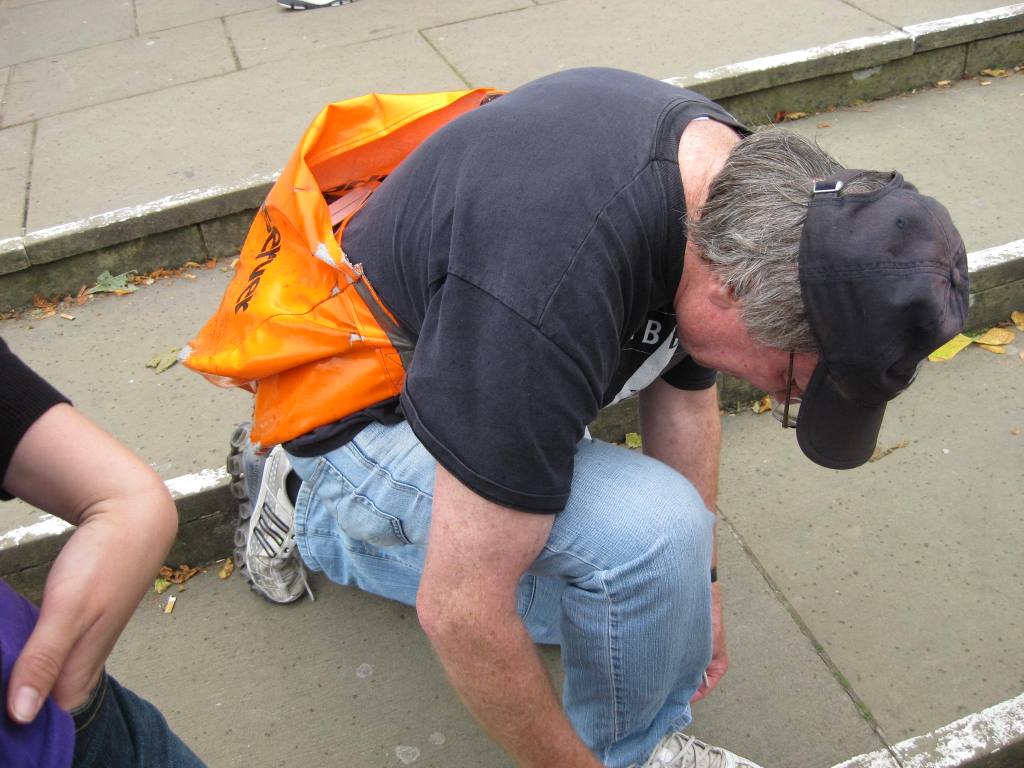
A few things have happened recently that have gotten me thinking.  Completely independently of each other, last week was London Fashion Week, and yesterday my friend wrote into the Guardian newspaper and her comments were published online!  Yes, you guessed it, the combination of fashion and the Guardian can only get one thinking about Bill's orange Guardian bag.  This bag has come to be an icon of many good things.  It represents walks with Bill when that bright, safety-orange bag was the only way you could find Bill to catch up with him in a crowd.  It represents what used to be the prize for the travel writing competition at the end of the term.  I remember being a student back in Ithaca seeing these very bright bags around campus and a friend of mine, who had just come back from his semester in London, looking at it mournfully and wishing he were back in London.
Fall, 2009
This is where we encounter the real issue.  This bag is disappearing from our lives.  The Guardian doesn't make them anymore, so we can no longer give them as prizes, and Bill's bag, which he has carried for many years, looks all the worse for wear.  The Guardian bag is becoming more and more a thing of the past.  Change is good, and Bill has a new bag now.  It's made by Manhattan Portage, it's more on the red side of safety-orange, and has a reflective silver stripe across it.  Content-wise, it probably carries about as much as the old Guardian bag, plus has a zip pocket on the front.  The new bag is held closed with velcro and also clips to hold it closed for extra security.  Bill didn't need this "extra security" in the old bag, he claims all he did with that one was carry really old sandwiches to put strangers off of reaching in and trying to steal term papers from him.  My main issue with all of this, though, is that Bill is a historian by trade.  His Guardian bag has iconic status with alums and symbolizes excellence in writing and walking tours all over London.  It's an ICLC tradition and it's fading in our midst.  Is it possible to begin a "Save the Guardian Bag" campaign?
Summer, 2007

I have looked on eBay, on Amazon, on the Guardian's website and come up empty handed.  These bags seem nowhere to be found.  Perhaps there is a museum out there that would like to de-accession a Guardian bag? 

Bill has a birthday coming up.  Any leads on Guardian bags would be much appreciated.

Thanks.
-Claire

24 February, 2011

The Many Forms of Travel

Travel- what can I say about it?  We all do it.  We travel to work, we travel to study, we travel for pleasure.  Travel to work is the one where we look for patterns.  You see the same people from day to day on your train or bus or in the street.  And when the pattern varies, you notice.  Perhaps so much so that you comment on it, for example, if your train leaves 2 minutes earlier than it is scheduled to leave so that even though you thought you were going to be on time you actually ended up having to wait 20 minutes for the next one, or if your bus is rerouted because the police have blocked off a sizable portion of the Walworth Road due to some undisclosed event.  Traveling to study is pretty obvious.  All our students got on a plane to come to the ICLC.  It's something interesting and different, and, unique compared to the other 2 kinds of travel, it's perhaps a once-in-a-lifetime opportunity.  Traveling to study is a springboard for a lot of traveling for pleasure for many of our students, too.  This is the kind where you have to hope that no patterns form and that each place is interesting and different.  I have noticed a few themes in study abroad inspired travel for pleasure.

There is the study abroad student who is determined to go to as many places as possible.  As a result, when their 4 months of study are done, they have also packed in trips to Paris, Dublin, Rome, Prague, Munich, Athens, Barcelona and Amsterdam.  And that's not including break week or trips with the ICLC.  This type of travel requires an enormous amount of energy and a love of waking up early/sleeping in airports.  I commend that dedication!

The next type of student travel is the one to family or friends in Europe.  This often takes students to places which are less tourist driven than the cities previously mentioned.  They might have cousins in Marseilles or friends studying in Marrakesh.  In this type of travel students often get a much more local experience by visiting someone who lives there.  They eat in small restaurants off the main roads and visit markets that they may not have found on their own.  And your hosts may even be your guides to take you to the highest point in Bratislava or introduce you to contemporary Estonian folk music.

Another type of travel that takes students to less obvious destinations is the mission to discover their European roots.  This has taken me to Ireland, France and Germany.  I have seen it take other students to Holland, Denmark, Brittany and Glasgow.  This type of travel can be tricky because it may be focused around a small or little known landmark, such as a house, farm, shop or street.  While finding these particular spots may end up being fruitless (my mother and I traveled all the way to Strasbourg before she admitted that she wasn't sure what her mother's house number had been as a child, though she was pretty sure she might be able to recognize it is she saw it in the row of buildings that all looked the same to me) getting there is usually a story in itself.  What makes this kind of journey even more difficult is not knowing whether the place you are looking for is actually still there or not.  My great-grandfather's family farm had been replaced by a shop that specialized in ceramic tiles.

The other type of student travel is the the UK based journey.  Some students prefer to get to know the ins and outs of London on their weekends or to save money on day trips to places like Brighton, Oxford and Cambridge.  Some students have family in the UK who they spend the day with and some use these day trips to case out possible graduate schools. 

I think most students fall under more than one of these categories at one stage or another during their stay over here.  Just to make it more interesting, the ICLC has competitions for break week.  There is a competition to bring back the tackiest souvenir and the postcard competition in which the card must be written in the native language of the country it is from and posted into the ICLC.  There are also the competitions that are judged at the end of the semester for photography and travel writing.  More details will be posted about the competitions.  Good luck and happy travels!

-Claire (not Elsie, she's away in Finland)

15 February, 2011

S11 Scavenger Hunt #3: More of John's London and a little of North London

This week we have another contribution from John Birk.  I'm beginning to get the sense that he's missing London.  John would like you to find where he took this photograph, perhaps on your way to travel to the continent, and take a photo of yourself sitting here.
***
I would like you to find an Angel in North London.  I don't just mean a photo of the Tube station.  Local area businesses have surely capitalized on this name, so it needs to be an image of an angel in Angel.  Happy hunting!

-Elsie (and Claire and John Birk)

11 February, 2011

Brush up on your Beatles trivia: 2 quizzes

So you think you're an expert on Beatles trivia?  Each quiz is worth tenner, going to the first person to give the right answers to Bill (don't worry, you don't have to answer both if you don't want to).

I.  Identify the song linked to the phrases below, and then, taking the first letter from each title, rearrange them to for a critical word for Scousers.
  1. Paul's song about John's son
  2. A home in Tuscon, Arizona
  3. The Albert Hall features in this song
  4. The girl was a big teaser taking the boy half-way there
  5. How did she ever pay the rent?
  6. Introducing Billy Shears
  7. Dancing through the night with a 17 year old
  8. Marshmallow pies and marmalade skies
a. What is the hidden word? 
b. What is its significance?
Email your answers to Bill if you want to win £10!
***
II. The following anagrams are portions of lines from Beatles songs.  The combination of the first letters of each unscrambled line forms something that is relevant to the Beatles.  The first correct answer emailed to Bill wins £10 (or a date with Paul McCartney if you're lucky).
  1. Zenith vain he ash
  2. Mediate dot junk
  3. Heated nurse
  4. Arched even twin
These are the real Beatles, right?

 May the best Beatles-quizzers win!
-Elsie

04 February, 2011

Sarah’s contribution to Liverpool

I am not Liverpudlian, until I worked for Ithaca I had not been to Liverpool, but there was a Liverpudlian boy in my life when I was 15. I did not go to school with him, but I met him on a week long First Aid Course on an Army base in Aldershot.  He was a nice boy with a strange accent that I hadn’t really come across before. There weren’t many Liverpudlians in Holland and for my year or so in England I hadn’t come across a real one either. I say ‘real one’ as there used to be a soap opera called ‘Brookside’ on TV that was set in Liverpool, so I was familiar with the accent.

The school I attended in England made you join the Combined Cadet Force from the ages of 14-16. You basically had a choice between joining the Army, the RAF or the Navy. My friend B promptly informed me that the Navy was the best as it was the easiest.  Seeing as I had never heard of the CCF before, I was still in shock from having to wear school uniform and call my teachers sir or miss, never mind the idea that I had to wear the Army, RAF or Navy uniform every Wednesday afternoon for 2 years of my life, I was easily persuaded. It was the best decision of my life. It turned out the RAF and Army CCF were quite hardcore. They were clearly not meant for me. I was much more comfortable in the Navy, where we occasionally had to practice how to march in rank and laughed away 2 years worth of Wednesday afternoons.  There was a serious side to it and I am quite the dab hand at tying knots!  They also made you go on a course in one of our holidays. B and I looked at our course options and quickly realised that a week long first aid course was for us.

We packed our bags and jumped on a train to the army base and this is where we met the Liverpudlian. As it turned out, there were two other boys from our school who had opted for the same course. It turned out that the two boys as well as B and myself were all Welsh...what could this say about the Welsh? All the other courses were all about the Navy and quite serious. We Welsh clearly prefer life skills and saving lives.

The first day we started with the basics, where to find the pulse. The aim was to introduce yourself to your neighbour by feeling their pulse. I was sat next to the Liverpudlian. I found myself a pulse and a new boyfriend. Sadly, throughout the week it turned out we were not meant to be. I felt we had too many differences;
• He opted to dress up in the navy uniform, I was made to.
• He was really into sailing, I wasn’t.
• He wanted to study medicine, I wanted to study fashion.
• He loved spending his summers in Southampton, I needed a map to locate Southampton.
• He had a Liverpudlian accent and I liked Scottish accents.

The Liverpudlian and I remained friends for about 2 years and he even came to visit me on his way to Southampton one summer. Just think, if it had turned out that we were meant for each other, I could be a Scouser who lives on a sail boat or in Southampton.

02 February, 2011

Liverpool is Remarkable

Yup, so remarkable that I took my wife…much to her horror: she thinks Venice is a proper setting for an anniversary weekend whereas I am more conscious of the environmental plight of the city with its overflow of tourists …to Liverpool for our wedding anniversary a few years back. Score after 1st inning: Bill 1 [for courage alone], Wife 0. No make that Bill 2, Wife 0, as my firm ‘friends of the earth’ stance deserves another point.  Of course, she got her own back by booking the most expensive hotel in town [after the Beatles themed ‘hard day’s night’ hotel] and the most expensive restaurant. Score after two innings: Bill 2, Wife 2.

But, as luck would have it, the advantage swung first her way, then mine, because the hotel, on HOPE Street, between the 2 cathedrals – a point for my wife as all marriages are ‘hopeful’ and this marriage is ‘between faiths’ as I come from a ‘Paddy’s Wigwam’ background while she has roots in sturdy establishment Protestantism [no way Venice can compete as it lacks religious diversity] - was also the location where Liverpool FC house their new signings until they get a flat or house of their own. So Rafa Benitez, now of Inter Milan, and Fernando Torres, now of Chelsea, might have stayed in our room, showered in our shower, slept in our bed.  Score after 3 innings: Bill 4, wife 3. Not to be outdone, more expensive restaurants were found [Score: Bill 4, Wife 4, Wallet minus 5], but I swiftly countered with the finest marble urinals in the world, at the Philharmonic, John Lennon’s favourite bar, where the great man no doubt sought relief on many occasions during his student days as he hardly ever went to class.  The ‘Phil’ allows escorted women to view the urinals [Bill 5, wife 4, wallet recovering as viewing the urinals is free]. Oops, I just scored an ‘own goal’ with the Phil’s marble urinals: Lennon was notoriously unfaithful to both his wives, clearly not a subject to be brought up on an anniversary weekend. Score after 4 innings: Bill 5, Wife 5.

Tension rose in the relationship as each sought the final advantage. We ferried across the Mersey and visited Port Sunlight, which didn’t change the score.  I suggested Stanley Park, she suggested Crosby Beach.  A stroll through a park [named after the same family which donated the Stanley Cup to the NHL Champions, but really to see the grounds of Liverpool FC and Everton FC which adjoin the park] or a stroll along a beach. OK, it’s August, let’s go to the beach…where 100 naked men stood staring out to sea. Final Score: Bill 5, Wife 6. Men will never win.


-Bill (Elsie is not Bill's wife)

01 February, 2011

All You Need is Liverpool

We all probably know a lot more about Liverpool than we think.  You have probably heard of Penny Lane and Strawberry Fields.  You may have also heard of Liverpudlian, Eleanor Rigby.  She was a local, so you clearly have more local knowledge than you thought you had.  The Beatles sang about what was around them.   They provided food for thought as well.  "Will you still need me, will you still feed me, when I'm 64?"  If you look around the London Centre, you might even find someone asking that question. 
Someone here was asking, will you still need me, will you still feed me?

You can be a Beatle, too!
In a few weeks we head for Liverpool on a trip that is pertinent to British Pop students, Sport in the UK students, British Youth Culture students, Art in London students and anyone who has ever liked the Beatles or Liverpool FC.  We will get to hear proper Scouse accents, which a few years back had a few students thinking they were hearing Swedish accents.  In fact, start training your ear now.  How much of what Liverpudlian comedian, John Bishop, is saying can you understand?  http://www.youtube.com/watch?v=JqgwO4zKKkw&feature=channel

For the art students among us, get ready for Crosby Beach!  Antony Gormley made 100 casts of his naked body which were installed in a few settings, but have settled on Crosby Beach.  Yes, this is like an ultra modern nude beach, where the statues are the naked ones.  The rest of us will probably be too chilly to strip down ourselves (this is not a challenge, just take my word for it).
Katie and Greta tried to warms up Antony in November 2009.
Keep trying to win Bill's quizzes on the trip, and I am offering a special prize to any student who bags Steven Gerrard!

-Claire

31 January, 2011

S11 Scavenger Hunt #2: John's London

This week's installment of the scavenger hunt is from John Birk, a guest blogger.  John is a lover of London and and has spent much time here.  As an explorer of London, his favorite thing ever to do in all of London is to go mudlarking on the banks of the Thames.  Have a look at his link to find out what mudlarking entails- http://www.thamesandfield.co.uk/.  You may also recognize him from the IC library as the man who wears the bow tie.  This week you have another specific place to find.  Good luck!

‘Tis a monument you seek, to be sure, 
At least one tube trip but not fewer.
On its base "twas blamed on popery,"
SPOILER ALERT “twas by protestant dopery”.
Your quest may start with the underground
Head to the east from South Ken be bound
Look for Doric, not Ionic, or Corinthian
Up or down may ren-der you a tizzy- in
Walk thee round and round and round again if this is the monument you seek.
Mind be hale and hearty else your round and round may leave you pained and weak.
'Tis a flame you seek,
'Bove your pate not your feet.
Photo should show you “apostle-like”.
My favorite London view is worth this hike.

21 January, 2011

S11 Scavenger Hunt #1: Rules, Regulations and Routemasters

This is the first installment of the Spring 2011 Scavenger Hunt!  Throughout the term Elsie will post things for you to find.  This is just for fun and a different way to get out and see London.  This term Elsie has decided to theme the hunt.  It will have to do with transportation.  As the deadline for entries will not be until the end of the semester, take your time and keep your eyes peeled.  In no particular order, here are some guidelines for the hunt:
  • All entries must be submitted in photo form.
  • The back of the photo must have the location it was taken and the entrant's ID# (don't put your name on them).
  • All entries from an entrant must be submitted at the same time.
  • All entries are subjective and will be judged by Elsie on the degree of immersion that they represent.
  • Unless stated otherwise, all entries must be photographed within the UK.
  • Please make sure you have permission to photograph your entries.
  • You don't necessarily need to submit entries for every object in the hunt.  It's quality that's important.
  • Teaming up with a partner (no more than 2 working together) is allowed, or you can go it alone.
  • The entrant must appear in at least 5 photos, showing them interacting with the objects that they have found.
Your first mission, should you choose to accept:
London has an amazing history, both ancient and modern.  The Routemaster bus was produced for London Transport in the 1950's and 60's, but was taken off the road in 2005.  This classic design allowed passengers to hop on and off the bus from the opening at the back and was a double-decker.  It was operated by 2 transport personnel, the driver at the front, isolated from the passengers, and the ticket checker in the back.  Often, if you pick up a souvenir model of a bus, this is the one you find.  These days there are plans for a new, modern Routemaster that is more energy efficient, but they haven't been put into action yet.  For now, the route of the number 9 bus is partially operated with the old Routemasters as a Heritage Route.  Now that you have all mastered using your Oyster cards, try out one of the old Routemasters and get a photo from it.

Your second mission:
I'm sure by now you have found some really breathtaking views of London.  It's different from American cities where much of the skyline is often made up of skyscrapers.  London gives the impression of being much more wide than tall.  There are some exceptions, such as Canary Wharf and the Gherkin, but for the most part, London sprawls to the north, south, east and west.  Walk up to the top of Primrose Hill to look across Greater London, or go to Greenwich Park to take in the City.  Or hop a train to Richmond and look at St. Paul's.  Yes, I mean St. Paul's Cathedral in The City of London.  You need to find the right break in the trees in Richmond Park at King Henry's Mound.  The only stipulation for this one is that your or your teammate must appear in the photo (there are a lot of images of this view on Google, so no cheating).

Good luck!
-Elsie

06 January, 2011

What Fall 2010 said...

As with any Ithaca College course, students fill out evaluations at the end of the term here.  One of the most popular questions is, "Do you actually read these?"  Bill, Sarah, Heather and I always smile and answer yes to this question.  Fall 2010 students, if you thought this was an empty response, prepare to be wowed.

Dear Spring 2011 ICLC students,
One of the questions that we ask in the evaluation of the ICLC is "What 3 things do you think are essential for us to tell you when you first get here?"  Here are some of the most popular answers:

  • "Learn about buses"- Buses are part of the Transport for London (TfL) system.  You can use your Oyster card on them, and the fare is less than that of the Tube.  You only have to tap your Oyster when you get on the bus.  They are great for getting a sense of the geography of London, especially from the top of a double decker bus.  Buses run throughout the day and night (24 hr buses and night buses) so they are particularly handy after the Tube has closed for the night.
  • "How to set up internet"- You must have a BT landline in your flat and have it switched on to get broadband.  Though you only want it for the 4 months that you are here, the minimum contract is longer so build the cancellation charge into the cost of turning the line on.  You can get your internet from other providers (Be There does short contracts), but the BT landline must be on.  If your flat does not have phone access you can get a dongle (that's what they're really called here, I bet they might be called something else in the USA).  Dongles can be bought from mobile phone providers and work on the mobile phone network.  You can buy a pay as you go version that you top up in the same way as you do a pay as you go mobile phone.
  • "The deal with transportation"- One of the most user friendly public transport systems in the world is London's Tube (this is what we call the subway).  The different lines have names and are color coded.  The system closes around midnight each night and opens around 5am the following morning.  It can be accessed with paper tickets, but are more cost effective if you use an Oyster card.  You must tap your card on the reader to enter the barriers and then tap it again at the barrier to exit.  As students you are eligible for student Oyster cards, which give you a 30% discount on travelcards (travel passes for a week or a month).  You can also top them up with prepaid money on them.  London is divided into zones in concentric circles and prices vary depending on which zones you are traveling in.  TfL has a website with info about all the forms of transport they offer www.tfl.gov.uk.  On most weekends there is construction work on the Tube and many line and station closures.  You can check the website for updates on travel disruptions, or sign up through the website to have the weekend closures emailed to you.  
  • "How Tube strikes work"- This past fall we also experienced Tube strikes.  These are union strikes, usually scheduled for a weekday beginning at 5pm and lasting around 24 hours.  Tube strike days are usually good ones to have plans to take the bus or walk wherever you need to go.  Bear in mind that these strikes DO NOT CAUSE CLASSES TO BE CANCELED. We are all crossing our fingers that there are not more Tube strikes.
  • "Emergency numbers"- 999 is the main number for the emergency services in the UK.  112 is used through much of Europe and is also an option in the UK.  911 can also be used, but it is not the best.  I'm not sure how the different numbers are routed to the emergency services, but just to be safe use 999 or 112.
  • "Introduce the professors"- Most of our faculty are of British extraction, with a few exceptions.  They lecture for us part time, and many also work for other universities.  Courses are structured more towards the British system than American, so there is more focus on essay writing than quizzes.  
  • "Get rent money out for rent early"- Most landlords take cash payments that students either deposit into the landlord's bank account or the landlord comes and collects.  Most do not accept checks in US dollars.  It can be very difficult to set up a bank account when you arrive here, so don't rely on that.  Because you are most likely going to have a limit on how much money you can withdraw per day start taking out your rent money a few days in advance.  Also remember that you will also have to put down a deposit with your first month's rent, so allow for the extra days of withdrawing cash during orientation week.  Unlike the USA which asks at the ATM if you would like to withdraw from you checking or savings, UK ATMs will automatically take from your checking.  Make sure that your money is in your checking, NOT your savings account.
  • "Common real estate agency practices"- Different estate agents will offer different deals, but remember that they are all trying to sell you something.  We have copies of old leases that you can read to see what they are like here in the housing room during orientation week.  Some you will need to chase up for internet access if that was offered as part of the flat.  We want you all living in safe places so remember to check for things like the record that the gas boiler (if there is one) has had its annual check.  Get everything about the flat in writing and if you aren't sure, feel free to ask any of the ICLC staff about it.  Clarify how and when your deposits will be returned to you when you move out of your flat.
  • "Relax, you'll find housing"- In the same vein, someone also recommended a reminder to breath.  These two are pretty self explanatory.  Same with "We will find a flat".  This statement is a fact.
  • "British slang"- We have a small dictionary of this waiting for you in your orientation pack.
  • "Learn that your [fake] British accent just doesn't cut it"- I fear this led to an awkward evening in a pub?  Not sure.
  • "There are no trash cans here, beware!"- That's not strictly true, though you will probably notice that you can't find a bin when you are looking for one.  There are generally none in train and Tube stations.  London has much experience in anti-terrorism measures, of which this is one (bombs in trash cans), and I believe this practice goes back to the days of the IRA.  I'm not sure if this is a fact, and I'm open to being told I'm wrong, but there are nonetheless fewer bins in public areas than you may find in America.

The fall 2010 groups also says to the spring 2011 students:
See you all soon!
-Elsie (and Claire)

10 December, 2010

'was' we robbed?

Forgive the Cockney colloquialism. But, last Thursday, December 2, 2010, according to most of the British press, both the USA and the UK ‘was’ robbed, stuffed, insulted, put in our place, humiliated, etc., etc., etc.  It will be long remembered, like the December 7th anniversary of the attack on Pearl Harbour, as another ‘day of infamy’.  Having apparently been promised more, the England bid to host the 2018 World Cup of Football earned a meagre 2 of 22 votes. Out in the first round! No chance to build on a reasonable platform after the elimination of the candidate country with the fewest votes. Football is not ‘coming home’! Half an hour after FIFA chose Russia to host in 2018, the delegates chose Qatar over the USA to host the 2022 event. A small but exceptionally rich Arab Emirate grabs the limelight from the USA. President Obama said the decision was wrong.

This rejection will leave a deep scar on the English psyche. They can’t bid again to host the World Cup until the 2030 tournament comes up for grabs [or should I say ‘up for bribes’?] In the USA, the rejection is more of a minor irritant.  Most Americans probably didn’t even know that the rest of the world was ‘cocking a snook’ at the sporting aspirations of the two major English-speaking nations. The FIFA Executive’s decisions to award the privilege of hosting the World Cups of 2018 and 2022 to Russia and Qatar, while positive in that neither nation has hosted before, fly in the face of the fundamental principle of sportsmanship – “may the better ‘man’ win”! President Obama said so himself: Qatar did not deserve to win!  For Obama it was Copenhagen all over again. Elements of the British press were more forthright, with the Daily Mirror calling Russia a “mafia state rotten to the core with corruption” and Qatar a “medieval state with no freedom of speech”. Ouch! Very sore losers!

Sore and, quite possibly, unfair losers.  Mike Lee, an Englishman who worked on the successful Qatar bid, said the nation should not blame others. While technically one of the best bids, England fell short because its early bid leader alienated FIFA executives.
England may not be getting the World Cup, but if they ever host a major international basketball tournament, I think Ed Gordon might be a future team member for England.

The underlying message in the British press is ‘corruption’. The probe in Rupert Murdoch’s Sunday Times  and the BBC’s Panorama expose did not impress the ‘dodgy fat cats’ at FIFA control. A bad odour hangs over the Zurich HQ of FIFA, and especially over its head, Sepp Blatter. After all, our Prime Minister, David Cameron of Eton, Oxford and the House of Commons, the soon-to-be Sir David Beckham of Manchester United, Real Madrid, the LA Galaxy, England, and Posh Spice, and Prince William of Wales, soon to be married to the Kate Middleton and  later to be king William V, had devoted endless hours of diplomacy and wheeler-dealing to get the games. What a waste! What a lost opportunity: it would have been a wonderful wedding gift to Wills and Kate! To compound the national misery, three to five FIFA voters even lied to the future king, to ‘golden balls’ Beckham, to our most famous member of the Bullington Dining and Drinking club.  If this were the 19th century we’d send a gunboat or two up the local creek to bang heads together. Sepp Blatter, FIFA President, even had the temerity to rub chilli vinegar into the sore by proclaiming that it was the Chinese who invented the game.  Outrageous! Every English school-child and every member of the ICLC’s SPUK group know the truth. It was the English who developed the rules and exported the game round the world. Talk about kicking a man when he’s down – 2 votes and erased from the history books as the inventor of the world’s most popular sport.

The USA will not feel the shockwaves so intensely.  Some will say: “Soccer! Who needs it when we have thoroughbred, proper, indigenous, home grown American games like football, baseball and basketball.  We’ll disclaim paternity of ice hockey as we understand our frozen friends up north have a better claim. Let the Russians and Qataris have their tournaments; we’ll keep the Super Bowl, the World Series, the final four and the Cortica Jug!” But others will recognise the lost opportunity to dig deeper roots of football in American parks, clubs, schools, universities and professional leagues. The US has the potential to be perennial World Cup champions if their best athletes rejected the siren summons of touchdowns [misnomer], homers and foul shots. American women know this. Why don’t American men follow the female lead?

The biggest surprise is that the Swiss are meant to be impartial. Now we know that this generalisation is only true of the greatest Swiss of all time, Roger Federer. FIFA does need investigation by an outside organisation. It seems odd in the 21st century that a small group of men should have so much power. Such a concentration of power invites corruption. Remember the Salt Lake City scandal. And how did London pip Paris at the post at the last minute to gain the right to host the summer Olympics 2012?

-Bill

Previous Posts