29 August, 2011

40 Things

Aldgate to Dulwich Library
  • Winks
  • Thieves with their treasure in a cave
  • The year Caligula was sole Consul of Rome
  • 5 x 8
  • Flood length
  • Maximum number of baseball players allowed on a major league team
  • The road between London and Birmingham
  • Top songs each week
  • Zirconium
  • 1 college junior + another college junior
Watch this space for more things to do with the number 40.  We want to be creative about how we celebrate turning 40 and we want creativity from the students, too. 

I think this has all the earmarks of a photo competition.

-Elsie

23 August, 2011

The Semester So Far

Another interview with Bill Sheasgreen.  Shame he couldn't make it to this one either.

Claire Mokrauer-Madden: Hi Bill!  Nice to see you again.  How has the Fall 2011 semester been going so far?
Bill Sheasgreen: It's been going really well.  I've been sizing up this semester's students, and I think we have the makings of a pretty top notch cricket team on our hands.
CMM: A cricket team?  Does cricket go this late into the year?
BS: Not usually, but I've been secretly planning an ICLC cricket team for years, and I think this will be the first season we can get it together.
CMM: Most of your students come from the United States.  Do they know how to play cricket?
BS: If you tell them it's for class they'll learn it.
CMM: But the class you're teaching is called London as Text.  Does cricket really figure into the class?
BS: I'm teaching the class, so of course it does.  But if I've misread the energy level of my class, we may turn into a rugby team.  It's still a bit early to know.
CMM: Who will your team be competing against?
BS: As I mentioned in my previous interview, there's a school down the road.  I think we'll start off competing with the children there, or, if they're too busy, perhaps we'll try and take on other American study abroad programs.
CMM: That sounds exciting!  You can start a league and a tournament!
BS: Yeah, I'm pretty excited about it.  I've also been at work designing the uniforms.  I'm really excited about them, too.
CMM: You talked a bit about uniforms in our last interview that you weren't at.  What's the story there?
BS: Not much of a story, really.  We are going to be a cricket or rugby team.  We'll have to have uniforms.  League rules.
CMM: I didn't think there was a league yet.  I understood that you were still trying to develop it.
BS: That's right.  And as I develop the league, I'm also planning the uniforms.  I plan on being the league president.  So uniforms will be my jurisdiction.  Here's an example of one of our students in a prototype uniform.  Plaid will figure prominently.
CMM: Hmmm, I like the direction you are going with this.  You're steering away from the classic solid colors that you see most teams wearing.  I can see the Scottish inspiration here.
BS:  Thanks.  Ok, I should be getting back to orientation.  It was nice getting to catch up with you again.
CMM: Yes, nice to touch base. I look forward to seeing how your new league goes.  I wish your team a lot of success!
BS: Thanks!  I really think this is going to be a good season for us.  I mean semester.

16 August, 2011

Don't be Dull

I like the film Four Weddings and a Funeral.  It came out in 1994.  In the film, a wedding guest asks Kristin Scott Thomas if she's a lesbian.  When KST wanted to know what made her ask that, she said it was a bit more interesting that asking if she just hadn't found the right man yet.  KST's response is to say, "Quite right.  Why be dull?"

In my own attempt to avoid dullness, here are some tips for a good semester at the ICLC:
  1. If you're in Bill's class, pretend to like cricket.
  2. Bring your water wings if you want to stay on the island. (I'm referring to the island of Britain.  Which one did you think I was talking about?)
  3. Try the biscuits.  Embrace McVities.
  4. If you're friends with David Tennant, suggest he come around for a visit.
  5. Don't rely on the Circle line.  It'll love you and leave you.
  6. Umbrellas will all break in the wind at some point.
  7. Follow the exchange rate like it's your Facebook newsfeed.
  8. Peanut butter and jelly is cheap.  Parks are free.
  9. You can make your own mac and cheese.  It may be different when the cheese has never been powdered, but different can be good.
  10. You can get prawn cocktail flavored crisps here.  Every day is an adventure!
This is David Tennant.  Learn to love this face.
On a side note, I recommend watching Four Weddings and a Funeral.  We're all adults here, but be warned, some of the comedy is pretty vile!  While not the most current film, it's a good taste of the British sense of humor, which is one of many vertebrae in the UK's backbone, and shows some nice footage of London.

-Claire and Heather (Four Weddings is Claire's recommendation)

    11 August, 2011

    Look out for Bill!

    I have little say about what Bill wears.  Because it's not that kind of office.  While we try to implement democracy where applicable around the ICLC, that isn't one of those places.  So I can't say what he'll be wearing or what he'll look like when he meets the group flights at the airport.  If you are in the Edinburgh group Bill will be at the airport with Steve TenEyck, and if you are arriving with the group on the 23rd he will probably be there with Sarah.  Again, two more wardrobe variables that don't figure into the democracy.

    Here are some likely possibilities of things to look for when you land (not so much part of the democracy, but regularly present at most airport pickups):
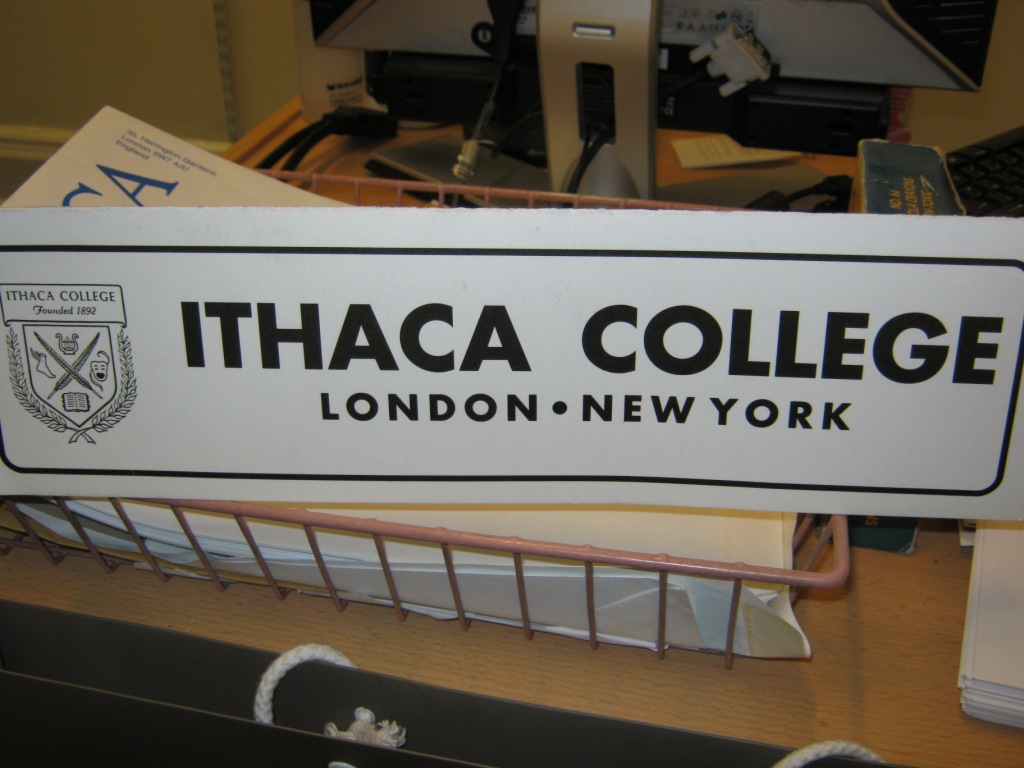
    They'll probably be holding signs like this.  They're not huge signs, but the writing is in a bold font so that even bleary, sleep deprived eyes can spot them, hopefully.

    If you miss the signs and end up going on a small wander around the arrivals hall, Bill will have his red messenger bag on him. 

    And if all else fails, this is Bill's face.  He will definitely have that with him.

    I think it goes without saying that Steve and Sarah will have their faces with them, too, but to tell you the truth, Bill was standing right in front of my office and was the most accessible to photograph.

    -Claire

    PS- If you're not arriving with the groups and you're making your own way to the London Center, here's what to look for:
    This is the London Center.  We're the end of the terrace and have the biggest chimney on the block!

    10 August, 2011

    Summer Madness

    I live in the London Borough of Hackney, one of London’s poorest boroughs. It is a typical inner city borough:  it has oases of gentility and privilege, schools are not particularly good but standards are improving, council flats [social housing] litter the borough map, asylum seekers and one-parent families find a home here and multiculturalism is a fact of life. Diane Abbott is our Labour MP: she is the first Afro-Caribbean woman to be elected to Parliament, is on the radical side of the party, and stood for leader after Gordon Brown resigned in 2010. To her credit she was on the streets of the borough this week urging the disaffected to think how rioting and looting was scoring an ‘own goal’ and was a slap in the face to everyone working to improve living conditions and life opportunities for the people in her constituency.

    The borough has not been immune to riots and destruction.  Hackney was bombed heavily during World War II because of its proximity to the City of London, the rail lines that snake their way through it and the reservoirs that contain the water supply for north-east London.  The house in which I live, built in 1874 [older than our London center], still carries the scars of Luftwaffe bombing.  Both pro- and anti-Fascist marchers took to Hackney streets during the ‘30s. Since moving here in the early ‘80s, there have been two serious riots, one linked to Toxteth [Liverpool], Handsworth [Birmingham] and Brixton [south London], occasioned by police victimisation of the Afro-Caribbean population, the other in 1990 occasioned by the Government’s highly unpopular Poll Tax legislation in Mrs Thatcher’s final years in office.

    Like most people of my generation, I’ve been on protest marches and attended demonstrations. I was part of the crowd during famous student protest against the Vietnam War in Grosvenor Square in 1968, I witnessed student rioting in Paris in 1968, I was tear gassed along with hundreds of other students in College Town [Ithaca, New York] in the early ‘70s [Vietnam and Cambodia]. And I had a brief but fascinating discussion with a protestor outside Hackney Town Hall on Mare Street, E8 during a ‘peaceful’ poll tax demonstration.  I had brought my young son along to the rally/vigil. About 10 minutes into the protest, a young man came up to me and said, “Get the kid out of here NOW.” I heeded this advice and, sure enough, as soon as we had unlocked our bicycles, all hell broke loose. At someone’s given signal, peaceful demonstration transformed into anarchist riot.

    I feel there are similarities and differences between the Poll Tax riots and what has happened in London these past three nights. First, a similarity:  there are people organising the “hit, smash, loot and burn” tactics: I saw two men last night on my HIGH STRET talking on a mobile phone about what shops were open, what closed – were they undercover policemen? Or were they part of the anarchist group? OR maybe, like me, they were just passers by talking on the phone?

    A major difference between the riots of 2011 and earlier ones is that the social media confer a distinct advantage to the rioters. Police response is bound to be slow and ponderous when compared to the speed at which a determined set of rioters can appear at a new venue. Another big difference between earlier riots and these is the lack [or at least weakness] of a legitimate cause.  Five days after the police shooting in Tottenham, is an explanation being articulated. Yes, the police shot dead a man last Thursday, possibly in suspect circumstances, but no report has emerged from the investigation.  Yes, life is tough for young people: university fees have risen to £9,000 a year [about $15k], jobs are scarce, the cost of living is rising, etc. There is more inequality in David Cameron’s Britain, public services are being cut, the economy [job creation] is sluggish, etc.  While the ‘us’ go to fashionable restaurants and send their offspring to exclusive private schools, the ‘them’ struggle to make ends meet.

    But the evidence so far is that the August 2011 rioting owes little to a sense of grievance about growing inequality and lack of opportunities. Another very human trait is at the fore, covetousness: you can get an expensive phone, flat screen TV and new Nike trainers if you hang around the High Road long enough.  Parents can’t control their offspring or, in some cases, parents have given their offspring a shopping list of goods to acquire.

    Maybe, I’m an optimist, but I feel that things will die down as quickly as they materialised, and there will be an autumn of trials, soul searching, media investigations and police reviews.  Condemnation is universal. Opportunistic snatching, burning and destroying don’t belong on anyone’s agenda in 2011. Let’s hope the contagion of this summer madness dies out soon.


    -Bill

    02 August, 2011

    Up North in the Land of Haggis

    During the fall 2011 term, many of you will spend several weekends traveling to various continental cities, all with a long history and numerous art and architectural treasures. There are cities and areas of outstanding natural beauty everywhere in continental Europe. And as you will find out, if you don’t already know, there are cheap flights –if timely booked – and even cheaper bus rides, that can get you there promptly and efficiently.

    But don’t forget the UK. Unlike my colleagues here, who holidayed in the Low Countries and Scandinavia this summer, I went up north to experience the Scottish highlands and islands. Some of you will be in Edinburgh for the festival in a few weeks time. For the most part Edinburgh is an attractive destination with its volcanic ridge spilling eastward down the Royal Mile past the Canongate – scene of the royal marriage this weekend – culminating in the Palace of Holyrood, scene of the royal wedding reception. The ‘new town’ to the north , begun in the mid-18th century when the ‘old town’ on the volcanic ridge had become an overpopulated slum, is one of the finest examples of neo-classical architecture and town planning in the world. Edinburgh, like Bath, another of our destinations, deserves its title as a UNESCO World Heritage site.

    But don’t rest in Edinburgh. The real gem that is Scotland lies further north. Standing atop Arthur’s Seat you can just see the first mountains [bens] that make up the highlands. Venture north to STIRLING, Loch Lomond, Fort William and you begin to see why Scotland has the reputation of being the most beautiful part of the UK. Home to the clans [who were mostly Jacobites, i.e., supporters of the exiled catholic Stuart dynasty], the  Highlands were ‘cleared’ [today we might say ‘ethnically cleansed’] in the 18th century both to diminish the threat from the belligerency of the clans, and because landlords found it much cheaper to turn the land over to sheep. After the Act of Union in 1707, when Scotland surrendered its independence to join with England, and the battle of Culloden in 1746, the London government and its allies legislated to remove the dynastic threat to the Protestant House of Hanover. Thus began the forced removal of highlanders to the British colonies, chiefly America, Canada, and eventually Australia.  Canada with its maritime province of Nova Scotia and its music and language traditions points inexorably back to the mother country. Indeed it can be said that while the USA is indebted to the Protestant Northern Irish, Canada owes a greater debt to Scotland [and, obviously, its ‘auld’ ally against England, France.]

    If you go further north to the off-shore islands, you find the roots of Gallic speaking Scotland in the Western Isles and of Scandinavian Scotland in the Orkneys and Shetlands.  I spent 4 days on the Orkneys, famous for remarkable Neolithic sites like Scara Brae and the Tomb of the Eagles, its Stonehenge like stone circles and its strategically vital 20th century naval base at  Scapa Flow where the German High Command scuttled its undamaged imperial fleet in June 1919 instead of allowing it to fall into the hands of the victorious French and English.

    Meet the right partner and this could be you one day!
    The moral of this blog is ‘go north young people, Scotland won’t let you down.’ But if you are planning to marry an Orkadian, beware the ’blackening’ tradition. Men and women planning on getting married are kidnapped, blackened with treacle [molasses], driven around town in an open flat bed truck, tied to the market cross in front of the cathedral for a suitable length of time, and then thrown into the sea to begin the process of washing off the treacle. Hmm! I’ve got nothing against marriage, but the Orkadians have invented a rather forbidding ‘rite of passage’ to the altar. No doubt, the Orkadians have the following passage in their wedding ceremonies: “What the people of the Orkneys have joined together, no one will separate as the sticky dark treacle will join them together for eternity.”

    So go north by all means, but don’t announce your engagement till after you return.

    -Bill

    29 July, 2011

    Tenterhooks- a True Story

    If a person is on tenterhooks, they are in a state of uneasy suspense or painful anxiety.  This originates from the hooks or bent nails that hold cloth stretched on a tenter (thank you, dictionary.com).  On a side note, a tenter is a frame that cloth is stretched on so that it dries evenly.

    The reason I bring up tenterhooks is because I was thinking of the excitement of getting ready to come over to London.  I know that you have packing to do, flatmates for find, money to sort out and summer jobs to wrap up, too.  But I remember being in your position.  With all that going on, I just wanted to get on the plane and come over to London!  My anxiety wasn't painful and there wasn't really any uneasy suspense, but I was waiting impatiently for that departure date to arrive.  I was so ready to be in London!

    Everything I'm about to relate truly happened.  You can ask my mom.

    There are only a few highlights of my own departure and arrival in London as a study abroad student that flash across my memory.  I knew what I wanted to pack, and I had everything laid out in organized piles in my room at home.  Of course I knew that they needed to be in a suitcase to get them over to London, but there they sat in my room until around 2am the morning of my flight (I think I was leaving O'Hare around 10am to connect to my transatlantic red-eye from Newark later that day) when I panicked and chucked my neat piles into my duffel bag and backpack.  I think I spent a lot of time sitting on my duffel, struggling to get it closed, and not a single moment of that night sleeping.  Another memory was my arrival at O'Hare.  My mother came with me to the check-in desk, and while I was waiting I was going through the checklist I had been sent.  I had my acceptance letter to show at the border, but I had completely forgotten to ask my parents to write me a letter of support to say that they would help me financially, if I needed.  So, very quickly, while waiting to check-in, my mom scrawled a note on the back of Bill's big summer quiz, which used to be posted to students in a big pack of papers (only some of the questions have changed in the last decade), to say that she wouldn't let me go broke while abroad.

    This next bit now causes me to shudder, since immigration is now a large part of my job.  When I arrived in London I hadn't really slept on the flight and I hadn't slept a wink the night before, so I was perhaps a little loopy from lack of sleep.  One thing I do know, there were two border agents at the desk I approached, the trainer and the trainee.  As a result I received a thorough questioning from the trainer who seemed to be setting an example.  I was baffled when I was asked my mother's maiden name, because she didn't change it when she got married.  Then, more importantly, they asked me how much money I had.  That was a much easier question, knowing the contents of my pockets.  "$5," I said.  "$5?" he asked.  "Yes," I said.  No problem, I hit that one straight out of the park.  He just stared at me.  "Anything else at all?" he asked.  "Nope," I said, still batting 1,000.  "You're telling me that you've just flown over from the USA with an empty bank account and no credit or debit cards?" he asked.  "Oh.  Of course I have those.  I thought you wanted to know how much cash I had on me."  Batting 500.  And I completely forgot to show him the note from my mom (though the state of it would probably just have attested to my disorganization even more).  Batting 0.  He rolled his eyes and stamped my passport, and I entered the UK.  In my defense, I hadn't had much sleep, but I'm not here to make excuses for my moments of delinquency.  I was a bit of a numpty that morning.
    Me as a study abroad student.  I'm the one in the middle
    The moral of my story is this: no matter how ready you think you are, get some rest and don't panic.  The upside is that I'm able to bring experience to my job. 

    -Claire

    PS- I'm pretty sure it's not usual to be asked your mother's maiden name at immigration.

    Previous Posts